Cleaning and drying
Start with dirt, oil and salt removal, then allow surfaces and seams to dry thoroughly.
A long-lasting underbody treatment is a system, not a single spray can. Frazer’s recommended approach uses preparation, targeted corrosion treatment, suitable primer and protective coatings where required. The stages are chosen after inspection and product compatibility is checked rather than applying every product to every vehicle.
Whether your priority is better appearance, inspection access or long-term corrosion protection, the first decision is always the right method for the surface. That includes recognising when metal repairs must take priority over a cosmetic result.
Discuss your project ↗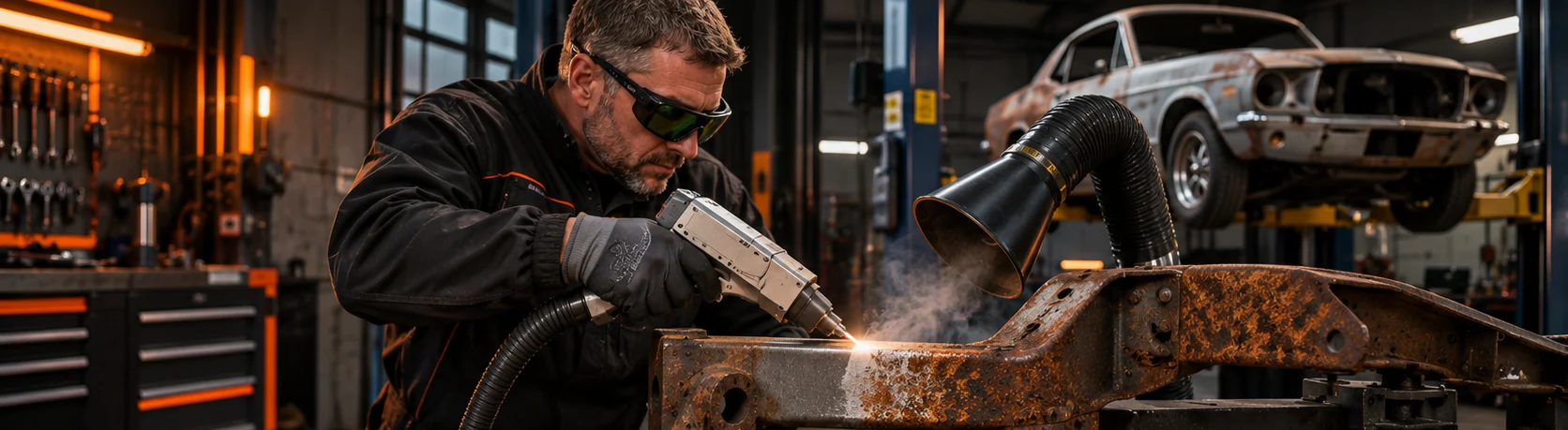 AI-GENERATED PROCESS ILLUSTRATION
For damp Irish driving conditions, surface preparation and material compatibility matter more than the colour or thickness of underseal. The right treatment sequence is assessed per vehicle and the products selected. The steps below explain the approach we can discuss for rust treatment and underbody protection.
Not every step or product belongs on every car. For example, wax systems and epoxy/topcoat systems can have different sequencing requirements. We avoid combining products without checking the manufacturer guidance.
Illustrations on this page are computer-generated examples of the technology, not photographs of completed customer work.
Every vehicle, finish and component is different. We focus on the considerations that genuinely affect the outcome.
Start with dirt, oil and salt removal, then allow surfaces and seams to dry thoroughly.
Use suitable laser or mechanical methods for accessible rust, with repairs where metal integrity has been lost.
Where needed, apply epoxy primer and topcoat, consider cavity wax for enclosed sections and finish with suitable underbody wax.
The visible result is only one part of responsible restoration. Before beginning we consider the substrate, corrosion severity, surrounding materials and practical access. Once cleaned, the surface may need immediate protection and, where appropriate, an inspection for hidden deterioration.
For underbodies and restoration work, this can involve degreasing, drying, accessible rust removal, compatible primer, topcoat, cavity wax and a suitable protective finish. Not every stage is needed on every job; the sequence is agreed after inspection.
EXPLORE THE TREATMENT PROCESS ↗Explore the services most often considered alongside this treatment.
No. Suitability depends on the material, condition, coatings, access and the end result. A condition assessment is the starting point.
No. Laser cleaning prepares appropriate surfaces; perforated or weakened structural metal must be properly repaired or replaced.
Compatible primers, topcoats, cavity waxes and underbody coatings may be recommended where appropriate. The final system depends on the specific project.
Send the vehicle or part details, location and issue through our enquiry form. A quote can be discussed after the scope and condition are assessed.
Send us the vehicle or part, the affected area and what you want to achieve. We’ll assess the next step.